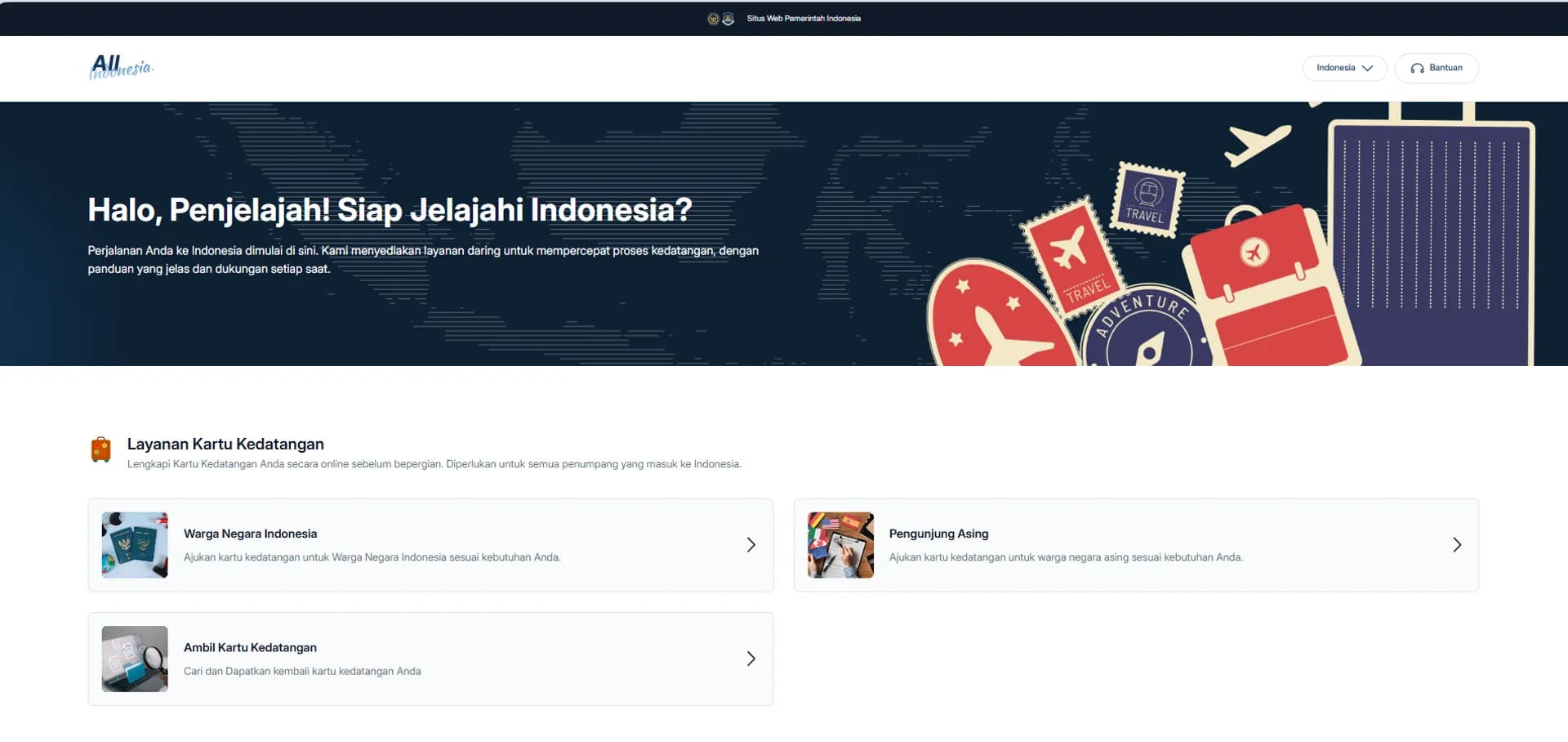
The Indonesian government has initiated a significant modernization of its border control with the launch of the "All Indonesia" digital portal. This new, mandatory system is designed to streamline entry formalities for all international and returning Indonesian travelers by consolidating previously separate declarations for immigration, customs, and health into a single, cohesive online process. The strategic implementation of this platform marks a fundamental shift towards a more efficient and paperless arrival experience.
The key aspects of this new policy are defined by a phased rollout. The system became mandatory for arrivals at Indonesia's three major international airports in Jakarta, Bali, and Surabaya starting on September 1, 2025. The nationwide extension of this mandate to all international airports, and potentially sea and land border posts, will take effect from October 1, 2025. A critical point of distinction is that this digital declaration is not a visa; it is a separate formality that complements existing visa requirements. The application process is free of charge and must be completed online via the official website or a dedicated mobile application within a 72-hour window prior to arrival. Pre-completion is highly recommended, as authorities have indicated that completing the form upon arrival will lead to significant delays at customs, immigration, and quarantine (CIQ) checkpoints. This comprehensive system aims to reduce friction for travelers while simultaneously enhancing the government's capacity for granular border management.
Introduction: Modernizing Indonesia's Entry Formalities
Indonesia is undergoing a strategic digital transformation of its entry procedures, moving away from fragmented, multi-step processes toward a singular, integrated platform. The "All Indonesia" portal represents the culmination of this effort, designed to centralize and simplify arrival formalities for all travelers entering the country by air, and potentially by sea and land. This initiative replaces a complex system that previously required travelers to navigate separate digital or paper declarations for customs (e-CD), health (SATUSEHAT), and immigration.
The portal is a sophisticated, inter-agency platform that integrates the declaration systems of the Directorate General of Immigration, the Ministry of Finance's Customs office, the Ministry of Health, and the Indonesian Quarantine Office. By bringing these disparate processes under a single digital roof, the government seeks to create a more efficient, user-friendly, and secure entry experience. This centralized approach ensures that information is collected once and made available to all relevant agencies, thereby eliminating redundant data entry and streamlining operations at control points.
The core objective behind this consolidation is to establish a "single source of truth" for traveler data. Instead of having separate databases and forms, the "All Indonesia" system creates a unified data stream that provides authorities with a comprehensive view of every traveler. This integrated approach not only improves operational efficiency and data consistency but also strengthens national security and public service delivery. For example, by consolidating health declarations, the government can collect real-time epidemiological data, enabling a more agile response to public health threats without having to create a new system from scratch. This policy demonstrates a modern understanding of governance, where convenience for the public and enhanced state oversight are mutually reinforcing objectives.
How the All Indonesia Arrival Card Was Rolled Out.
The implementation of the "All Indonesia" digital arrival card is being conducted through a calculated, phased rollout to ensure a smooth transition and minimize disruption. The initial activation of the new system began in mid-August 2025. This was followed by the first major phase, which began on September 1, 2025, when the "All Indonesia" declaration became mandatory for all travelers arriving at three of the country's busiest international airports: Soekarno-Hatta International Airport in Jakarta (CGK), Ngurah Rai International Airport in Bali (DPS), and Juanda International Airport in Surabaya (SUB).
The final and most significant phase will commence on October 1, 2025, at which point the system's mandate will be extended to all international airports across the country. This includes airports such as Komodo, Makassar, Manado, Medan, and Sumatra, which are already being incorporated into the system. The government has also indicated that sea and land border posts could be affected by this mandate from October 1, 2025, further extending the system's reach.
The decision to implement the system in a phased manner is a classic risk mitigation strategy for large-scale digital projects. Rather than launching a nationwide mandate all at once, authorities are testing the platform under high-volume, real-world conditions at the country's primary gateways. This allows them to identify and resolve any operational issues before the system is extended to all entry points. This measured approach prioritizes system stability and a positive user experience, demonstrating a pragmatic and forward-looking commitment to the program's success. The initial phase serves as a public trial, allowing the government to fine-tune the system and build public trust, signaling to both the travel industry and visitors that Indonesia is committed to a seamless and efficient digital transformation.
A Unified Declaration: Combining Immigration, Customs, and Health
The "All Indonesia" portal unifies three previously distinct arrival formalities into a single, comprehensive digital form. This integration simplifies the process for travelers by bringing together:
Immigration Data: The form collects basic travel information, including passport details, travel dates, flight information, and the purpose of the visit.
Health Declaration: It incorporates a health screening component that replaces the now-obsolete SATUSEHAT health pass. Travelers are required to declare any recent health symptoms and list the countries they have visited in the last 21 days.
Customs Declaration: The system’s electronic customs declaration (e-CD) component requires travelers to declare any items they are bringing into the country, such as alcohol, tobacco, cash exceeding IDR 100 million (or its foreign currency equivalent), and other restricted goods.
A particularly noteworthy component of the new system is the mandatory registration of electronic devices. The form requires travelers to enter the IMEI (International Mobile Equipment Identity) number for any mobile phones, handheld computers, or tablet devices that they are bringing into Indonesia. This data collection goes beyond a simple declaration. It is a strategic measure designed to regulate the import of electronic devices and combat illegal grey market trade. By linking a specific device to a traveler, authorities gain a powerful tool for monitoring and enforcement. This feature underscores that the "All Indonesia" portal is not merely a convenience tool for visitors but a robust instrument for comprehensive border management and economic regulation.
Crucial Clarification: The "All Indonesia" Card is Not a Visa
One of the most frequent sources of confusion for travelers is the distinction between the "All Indonesia" arrival card and a visa. It is a fundamental point that must be clearly understood: the two are separate and complementary requirements, not interchangeable. The "All Indonesia" card is a mandatory digital declaration that all travelers, including Indonesian citizens, must complete to provide information to immigration, customs, and health authorities. Conversely, a visa, such as a Visa on Arrival (VoA) or an electronic Visa on Arrival (e-VOA), is the legal permit that allows an eligible foreign national to enter and stay in Indonesia for a specific duration.
Travelers must first determine if their nationality and purpose of travel require a visa. If a visa is required, they must obtain it in addition to completing the "All Indonesia" arrival card. The digital card does not confer any legal right of entry on its own. It is a declaration of intent and a collection of data, whereas the visa is the formal permission to enter the country. The following table provides a clear comparison of these two distinct travel requirements.
Feature | All Indonesia Arrival Card | Visa on Arrival (VoA) |
Purpose | Mandatory digital declaration for entry | Legal permission to enter and stay |
Cost | Free | IDR 500,000 (~USD 35) |
Application Window | Within 72 hours of arrival | In advance (e-VOA) or on arrival |
Required for | All travelers (foreign and Indonesian) | Eligible foreign nationalities |
Result | A scannable QR code | A visa stamp or e-VoA document |
Notes | Cannot be used for visa purposes | Required for legal entry, separate from the arrival card |
The Traveler's Guide: A Step-by-Step Application Process
Where and When to Apply
Travelers must complete the "All Indonesia" arrival card exclusively through official government channels to avoid fraudulent websites. The only valid platforms are the official website, allindonesia.imigrasi.go.id, and its dedicated mobile application, which is available on both the App Store and Google Play Store. A crucial detail is that the application is entirely free of charge, and travelers should be wary of any third-party services that attempt to charge a fee.
The form can only be submitted within a specific 72-hour window before the scheduled arrival in Indonesia. Attempting to apply earlier will result in the system rejecting the application. This short window ensures that the provided information, such as health declarations and flight details, is as current as possible upon arrival.
Required Information: A Detailed Checklist
The online application process is designed to be completed in just a few minutes, with the platform splitting the required information into several key sections:
Personal Information: The form requires standard biographical data, including full name, passport number, date of birth, nationality, email address, and phone number. For convenience, travelers can use the MRZ (Machine Readable Zone) feature to auto-fill these fields.
Travel Details: Travelers must provide their arrival and departure dates, along with the name of the airline, flight number, and the specific airport of arrival.
Accommodation Details: The exact name and address of the hotel, villa, or other residence where the traveler will be staying are mandatory.
Health and Customs Declaration: This section requires a declaration of any recent health symptoms, a list of countries visited in the past 21 days, and a declaration of any goods that need to be cleared by customs. This includes items like alcohol, tobacco, cash exceeding certain limits, and other restricted or dutiable items.
Electronic Devices: The form also requires the IMEI number for any mobile phones or tablets that a traveler is bringing into Indonesia for personal use.
Submission and Arrival
After successfully completing the form, the system will generate a unique QR code, which is then sent to the traveler via email. It is imperative to have this QR code readily accessible upon arrival. To prepare for the possibility of unreliable Wi-Fi at the airport, it is highly recommended that travelers save a screenshot or download the QR code to their phone and, as a backup, print a physical copy.
For travelers who arrive without having completed the form in advance, entry is still permitted. However, they will be required to complete the "All Indonesia" declaration online at the airport by scanning a QR code provided at the control points. The government has issued a clear warning that this on-arrival process will cause significant delays at CIQ checkpoints, as it takes time to process the data. This built-in disincentive is a deliberate behavioral design choice intended to encourage pre-completion and ensure the system's overall efficiency for the majority of travelers.
Conclusion: A Step Towards a Seamless Travel Experience
The implementation of the "All Indonesia" digital arrival card marks a significant and forward-thinking step in the modernization of Indonesia's border management. This new system fundamentally shifts the burden of paperwork from a fragmented, often stressful on-arrival experience to a streamlined, digital pre-departure process. By consolidating three separate declarations into a single, intuitive platform, the government is not only enhancing traveler convenience but also strengthening its capacity for data-driven governance.
For the travel industry and travelers, this new system offers clear benefits. For frequent business travelers, the platform promises faster transitions and reduced downtime, bolstering Indonesia's appeal as a business destination. For tourists and families, the elimination of paper forms and the ability to complete the declaration for multiple travelers on a single form greatly reduces stress and confusion upon arrival. The system’s design, which subtly encourages pre-completion to avoid delays, demonstrates a pragmatic approach to ensuring high compliance and maximum efficiency.
Ultimately, by aligning with global trends in digital border control, the "All Indonesia" arrival card sets a new standard for a modern, secure, and traveler-friendly entry experience. While it is crucial for travelers to remember that this declaration does not replace their visa requirements, embracing this digital change will allow them to navigate Indonesia's entry formalities with greater ease, ensuring a smoother start to their journey.
See what your passport needs for Indonesia: https://myvisitvisa.com/visa/indonesia